Showing posts with label chocolate watchband. Show all posts

Tuesday, May 5, 2015

Northern California Spotlight: The Chocolate Watchband - Are You Gonna Be There/No Way Out


Back to San Jose, California for more of our Nor Cal region of the epic Battle of the Garage Bands.

The Chocolate Watchband recorded for producer Ed Cobb between '66 and '68 down in LA. The recordings don't always feature all of the band as Cobb had a penchant for bringing in studio musicians. He even went so far as to record instrumentals with not a single member of the band in it (think Expo 2000) and even vocal songs with a different singer (think Let's Go, Let's Go, Let's Go!).

Are You Gonna Be There was written for the band by Cobb's friend and LA songwriter, D. Bennett (who occasionally sang lead on these records as well) and was the third, and last, single under their name (they had done a 4th under the pseudonym of The Hogs). It was released on Tower Records in October of 1967.

The Flip-Side of Are You Gonna Be There is the excellent quasi-instrumental, No Way Out. That song gets an Ed Cobb credit for composer. That said, credible claims by the band suggest they were really the composers of the song. Producers aren't always so honest, you know. The pairing of the two strong songs, the quality of the production and the quality of singer David Aguilar's voice make this one of the most desired singles out there.

Until next time, we'll see you On The Flip-Side!

Thursday, April 30, 2015

Northern California Spotlight: The Mourning Reign -- Satisfaction Guaranteed/Our Fate


[Please see the comments section below for a comment from the band's singer, Beau]

Day 2 of our Nor Cal Battle of the Garage Bands.  1966 is the single greatest year for rock-n-roll ever. 1956 was good too, but no 1966. 1977 was also a critical year, but falls far short of what went down across the globe in 1966.

Let's back up a bit. A few short years prior to '66, rock-n-roll in America was desperately treading water. The record stores had been flooded with a tsunami of over-polished crooners with faux pompadours and plaid dinner jackets who were being sold to America's precious daughters as a safe alternative to true originals like Chuck Berry. Elvis was no longer a ground breaking, dangerous rocker, he was a well quaffed sell-out actor. Gene Vincent himself had sunk to crooning and Buddy Holly and Eddie Cochran were the earliest victims of rock-n-roll's toll. True, faint flickers of life could occasionally be glimpsed on the horizon. In Los Angeles Dick Dale was not very quietly creating an entirely new genre of rock-n-roll starting in '61. But it hadn't reverberated yet. In Texas, for a few brief years, starting in '62, Bobby Fuller tried to keep the Holly spirit alive. And in 1963 in Portland, Oregon, the Kingsmen recorded the single most important rock-n-roll record ever, Louie, Louie. But the record was immediately banned across the country and the Hoover-led FBI launched an investigation of obscenity and effectively put out the flame before it could spread too far...in this country. Then The Beatles appeared on the Ed Sullivan Show and the tsunami of schlock was itself washed out by the British Invasion, which, thankfully, restored rock-n-roll to its birthplace. Those who couldn't make the football team (and some who could) went to Sears Roebuck and bought themselves a new Silvertone Guitar and declared war on the neighborhood barber. The frustrated radio station engineer implemented dreams of becoming the next George Martin and started moonlighting as a record producer. Club owners and a host of other entrepreneurs eager to make a dollar on the biggest craze since the hula-hoop formed what would pass as local "record labels". Of course, none of these people knew what they were doing so the revolution was delayed a few months. In the meantime, flying in the slipstream of the Beatles, more aggressive Brit bands -- bands hugely influenced by Louie, Louie -- like the Yardbirds, the Rolling Stones, The Who and the Kinks found an audience in the US. And then, very early in '66, the perfect storm hit. That band in San Jose had put in enough practices in dad's garage that they were now winning the battle of the bands contest. Grandma quietly slipped Dave $150 to cut a record and follow his passion. The owner of Rock-n-Rollerskate, the bestest teen night spot in all of San Jose, was ready to put some bucks down to record that band and maybe make some more money at the concession stand by selling a local record. And Ed, the frustrated audio engineer, had his recording studio all set up in the back of the local appliance store, It's A Wash. The time was now. No editors. No suits. No record company men to say who could and could not record. This was the moment. And all across the world -- in America, Australia, Holland, Sweden and countless other places -- like a brood of cicadas, the now long haired rockers crawled out of the garages adorned in chelsea boots, three button jackets, paisley vests and dark wrap around sun glasses to make their first record.
Within a year the record company executives would reassert their control and descend on towns like San Jose, California, Amsterdam, Sidney, and Stockholm and swoop up the bands deemed valuable and crush the bands that showed no utility. But in that one brief moment of 1966 -- wedged between the chaos of innocence and the unassailable rule of record companies -- millions of bands recorded their song. Some awful. Some brilliant.
Today's song is one of those brilliant songs from '66. It's by the stunningly obscure San Jose, California quintet, The Mourning Reign. The song, with a clear play to the Rolling Stones, is called Satisfaction Guaranteed. A snarly guitar riff is spurted out with an unrelenting attack. The singer, some bloke named Beau (Bo) Maggie, does his best Mick Jagger swagger: "As you wander around, you find your imagination standing upside down in the mouth of mass hallucination. You are dissatisfied with the other guys you tried. Now don't you think it's time for a change, because, you know, Satisfaction Guaranteed!" Cue the double guitar lead that no respectable music exec. would have allowed. "Listen boys, you can't be playing over each other like that. It's just noise. Nobody will buy this record if you do that." Thank goodness their was no record exec. at the mighty Link Records in San Jose.

The flip side is the Beau Maggi composed Our Fate. We get a great Rickenbacker rhythm guitar part from more Steve Canali before Johnnie Bell jumps in with the relentless scorching guitar. Craig Maggi on drums and Charlie Gardin on bass lay down a substantial bedrock for the song. 

Unlike their San Jose brethren, The Chocolate Watchband, The Count Five and the Syndicate of Sound, the Mourning Reign wouldn't get the chance to make an album. They only recorded one other single and then disappeared into nowhere. Perhaps it was into that "invisible door" or that "hole in the floor" the singer is so desperate for us to know about.

Until next time, we'll see you On The Flip-Side!

Friday, February 28, 2014

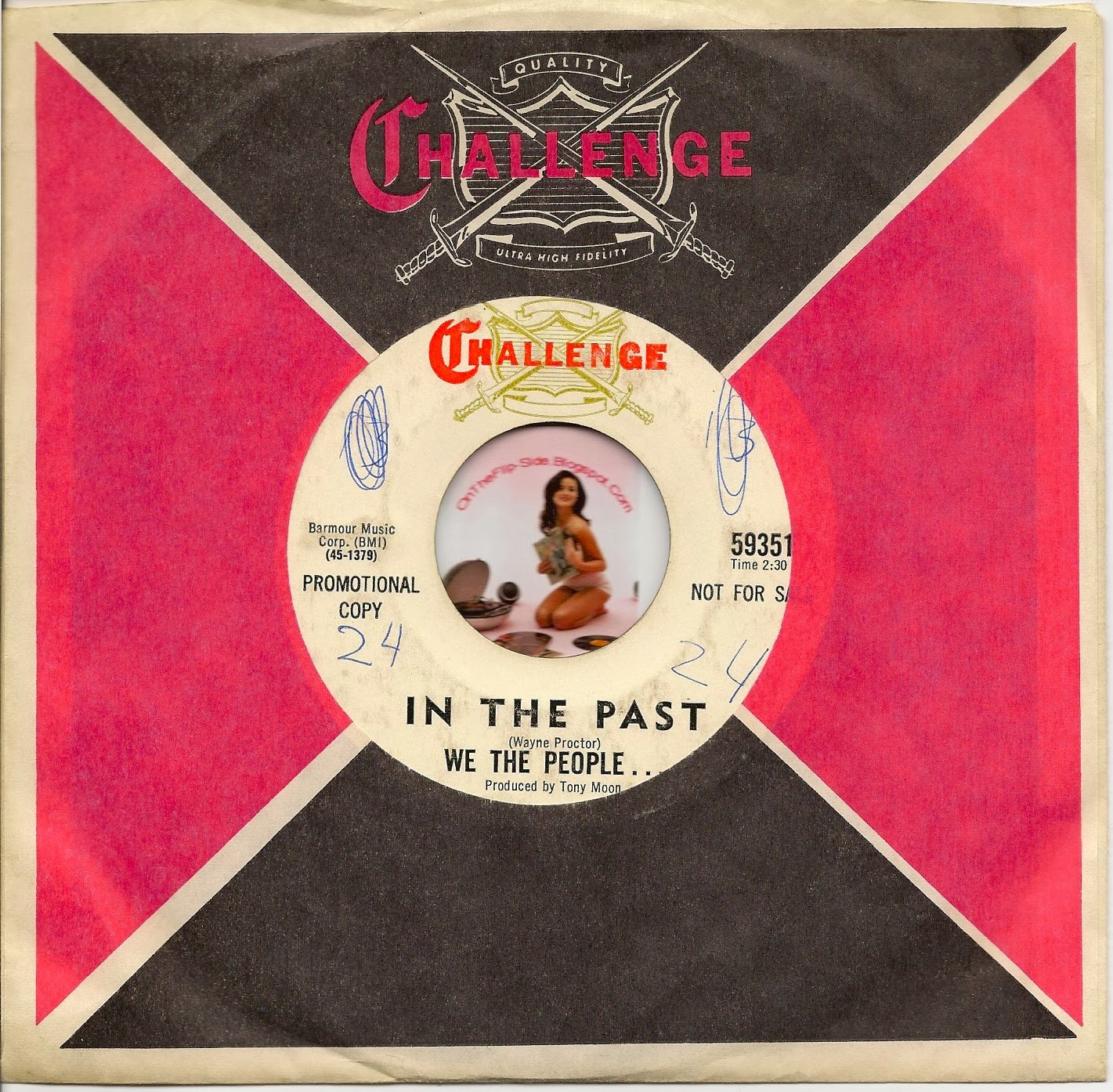
Song of the Week: We The People - In The Past

I first came to this song by way of The Chocolate Watchband's ethereal cover. Then I heard this, the original version. Wow. I mean, just...wow! 

We The People hailed from Orlando, Florida and put out a series of amazing and unique singles between 1966 and 1968. In The Past was the band's 4th single and was released on Challenge Records in December, 1966. The song was written by guitarist, Wayne Proctor, and features a unique instrument they called an Octachord, an eight string mandolin of sorts. Tommy Talton, David Duff, Randy Boyte and Lee Ferguson rounded out the rest of the band.

In an effort to avoid the Vietnam War draft, Wayne Proctor, left the band in '67 to enroll full time in college. So it was, like many other bands of the era, it was over. Just like that. 


Tuesday, October 4, 2011

Song of the Week: The Standells - "Medication"


Listen - The Standells perform Medication

We're building off our last post. The same label, the same producer, the same year and probably the same studio (and maybe even musicians) as our Chocolate Watchband post just below.

Most people know The Standells for their out of the garage hit, Dirty Water. That song, written by producer Ed Cobb, has led most people to believe the band is from Boston. Cobb was, but not the Standells. The members of The Standells all hail from LA and even had a long history in the film scene in LA. One of them was even a Mousekateer. Like the San Jose based Chocolate Watchband, The Standells were a real band and had been kicking around the LA scene in one form or another since the late 50's.

When Mouskateer escapee, Dick Dodd, left the surf combo, The Bel-Aires (known for their regional hit, Mr. Moto), the band began to take a more modern shape. Dodd took over singing duties and the band, like all others around them, became hugely influenced by the British Invasion. The band released a few forgettable singles on Liberty Records and VeeJay Records. They even performed a number on the TV show, The Munsters. Here is where Ed Cobb enters the picture. Cobb was looking for a group to market on his Tower Records label and The Standells fit the suit. They immediately hit it big with Cobb's homage to his hometown of Boston, Dirty Water. An inconsistent album of the same name followed. The first song off of that album is our SoTW.

The song is Medication, and, to tie it back into our last post, The Chocolate Watchband also did a version of the song. It's a beautifully produced, well restrained song that keeps our fingers snapping every time. 

Monday, November 23, 2009

Song of the Week: "Deuces Wild", Link Wray

{Right click here to listen to Link Wray perform our SoTW, Deuces Wild, while you read this lovely article.}

Have you ever seen the diminutive little primate from Madagascar they call the Aye-Aye? It's one strangle looking creature. It doesn't look like a primate, but it's not quite a rodent and it's not quite a feline either. It's so strange as to make you stop and take a look. Invariably you make an audible query to no one in particular: "What is that? It looks like some sorta missing link or sumpin'." (in this theoretical conversation, you speak with a poor colloquial American accent, sorry.)

What the hell does an Aye-Aye have to do with our SotW you ask? Good question. An Aye-Aye, I propose, is like our artist this week. That artist is primitive guitarist Link Wray who, in his day, sounded nothing like anyone else. How refreshing is that? Link Wray and his Raymen -- brothers Doug and Vernon and bassist Shorty Horton) first appeared in record bins in 1958 with their instrumental hit, Rumble. The song was tagged as subversive and banned. (Take a second to let that sink in. An instrumental was banned! I know of no other instrumental that has ever been banned.) Suddenly Link Wray and his Raymen were in demand in the clubs of their adopted home of Washington, DC.

Let's back up a bit. Link Wray (born Fred Lincoln "link" Wray Jr.) was perhaps the most unlikely person to become a pop star. Link was the son of two preachers, one caucasian, the other a Shawnee, who grew up in rural Dunn, North Carolina. After a stint in the Army, Link landed in Norfolk, Virginia where he hooked up with his brother Vernon who was trying to make it as a singer. The band relocated to Washington, DC around 1957 where they got a gig as the house band on Milt Grant's House Party, a local teen dance show. By now they were playing as Lucky Wray and the Palomino Ranch Hands. It was here that they improvised the rough strewn song that would become known as Rumble to cover the intro and outro of a commercial break. The record took off locally and the band was now known as Link Wray and the Raymen (also, the Wraymen).

For the next few years Link Wray and the Raymen would record numerous singles, and the occasional album filled with gritty and beautifully sloppy, under-produced instrumentals (with the occasional vocal number thrown in) in their own recording studio which was actually a converted chicken coop. Link preferred the cheaper guitars and had a special affinity for the easy to overdrive Danelectro Longhorn played through a small Premiere 71 amp. As he was also largely deaf, he liked to play loud. Today's SoTW, is illustrative of such a recording. It's Deuces Wild, the 16th single from Link Wray and the Raymen, and it's a wild romp of a song recorded in the sweltering summer heat of Washington, DC in 1964. That's right, this torture device of a song was recorded in 1964. The Beatles had just played their first ever gig in America just down the street from where Link Wray recorded in his chicken coop. The Kinks and The Who were for the first time ever entering the British studio with American producer, Shel Talmy. Things were about to change in America. But in the chicken coop, the Raymen were running through yet another of Link's demented instrumental compositions. These didn't rely on a deft right hand like Dick Dale's numbers, they didn't require exquisite production as did those of The Shadows, and they didn't rely on undeniable melody lines as did the songs of the Ventures. Link Wray and the Raymen did it with brute force. They performed with the primal force of an Aye-Aye (okay, Aye-Aye's aren't known for primal force, but I need to circle back and wrap this puppy up...so work with me). Link Wray's work became hugely influential to the next generation of songwriters such as Ray Davies of The Kinks and Pete Townshend of The Who. Pete Townshend noted in 1970, "He is the king. It if hadn't been for Link Wray and Rumble, I would have never picked up a guitar."

Now sit back and enjoy the human Aye-Aye, Link Wray, perform his 1964 composition, Deuces Wild. This is some wild and wooly stuff.

Friday, May 8, 2009

Video Diary: The Chocolate Watchband, "Sitting There, Standing"

The Chocolate Watchband perform Sitting There, Standing as seen in the 1967 movie, Riot on Sunset Strip. The video/audio sync blows, but you get the picture.