Showing posts with label gram parsons. Show all posts

Tuesday, November 26, 2013

Song of the Week: First Aid Kit - Emmylou


Johanna and Klara Söderberg hail from Enskede, Sweden. In 2012 the young sisters released The Lion's Roar, their second album, on Wichita Records. The second single from that album, Emmylou, traces the love stories of Johnny Cash and June Carter as well as that of Gram Parsons and Emmylou Harris, and compares them to their own lives. The tight harmony country-esque number reached the top 25 in Norway and Sweden, but failed to make an impression here in the states. We think that's a shame.
Until next time, we'll see you On The Flip-Side!

Thursday, November 21, 2013

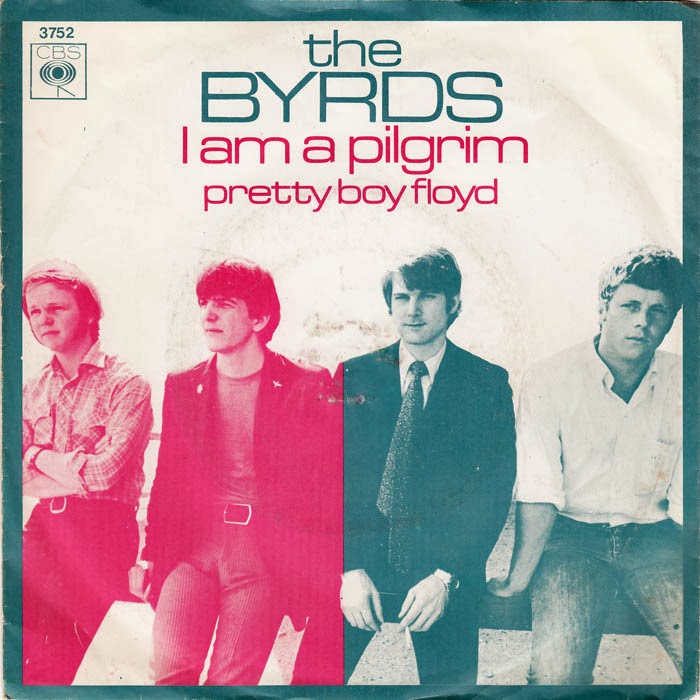
The Flip Sides of The Byrds' Singles: Pretty Boy Floyd, Drug Store Truck Drivin' Man

Pretty Boy Floyd
For the 14th single, Gram Parsons was now clearly exerting a massive influence in the band. But the man with the plan was Chris Hillman. Hillman was firmly ensconced as a primary songwriter in the band and it was he who began pushing the country sound and many critical personnel changes, including using Clarence White as a studio musician and bringing in Gram Parsons to replace David Crosby. Hillman gets songwriting credit for the A-Side, I Am A Pilgrim (Though we agree with the commenter below, it's a traditional song that predates the Byrds). For the Flip-Side Gram Parsons pushed the Woody Guthrie number, Pretty Boy Floyd. Because of contractual issues, Gram Parsons could not sing the lead, leaving Roger McGuinn to more than ably handle the duties. John Hartford plays banjo on the number. I'm unsure of who plays the fiddle and the mandolin. 
Drug Store Truck Drivin' Man
The only 45 from The Byrds to show Gram Parsons name as a composer didn't even feature Parsons. By the time Drug Store Truck Drivin' Man was recorded and released in January of 1969, Chris Hillman and Gram Parsons had flown the coop and reunited with ex-Byrds, Michael Clarke to form the Flying Burrito Brothers. That left McGuinn to do the lead and the harmony singing. Guitar wizard Clarence White takes over lead guitar, John York was on drums and Gene Parsons picked up the pace at drums.

Friday, July 26, 2013

A&M Records Spotlight: The Flying Burrito Brothers - Older Guys

From 1970, we have the ground breaking Alt. Country pioneers, The Flying Burrito Brothers, performing Older Guys. Three members, Gram Parsons, Chris Hillman and Michael Clarke came from The Byrds. Bernie Leadon played guitar and also appeared on the Dillard And Clark song, Out On The Side, which was featured just two days ago. Sneaky Pete Kleinow rounded out the line up.

Until next time, we'll see you On The Flip-Side!

Wednesday, July 24, 2013

A&M Records Spotlight: Doug Dillard and Gene Clark - Out On The Side/Train Leaves Here This Morning

Out On The Side

Train Leaves Here This Morning
[originally posted, November, 2008]
Enigmatic. That might be the best word to describe Gene Clark. Unlucky, under appreciated, brilliant, secretive, phobic, handsome, distant, pioneer, shy, obtuse, complex. These words also describe the gentle throated Clark. For most, the word that comes to mind when they hear the name Gene Clark is...who? Okay, let me give a little back story on Clark before we move on to this week's song.

Gene Clark, while his name remains unrecognizable to most, has perhaps one of the most recognized voices in rock history. That's because Gene Clark, once a singer for the dreadful New Christy Minstrels (that's him singing beautifully at 2:03), was all-too-briefly, a founding member of The Byrds. From 1964-1966, Gene Clark was the smooth baritone voiced, tambourine tapping, harmonica playing, center-stage standing, lanky frontman of the world's coolest looking band, The Byrds. His voice created the perfect bottom to David Crosby's falsetto and Roger McGuinn's nasal midrange. But more than that, Clark was The Byrds' most prolific songwriter. In an era of American bands rushing to perform their best Beatles knock-off, Clark wrote (and sang) unique songs that owed as much to his rural Missouri roots as to any other influence. Lyrically his songs were introspective and approached the subjects in a roundabout manner that forced the listener to puzzle together the real meaning. Musically, Clark's Byrds-era songs, such as the stunning Set You Free This Time, featured unexpected chord progressions and strangely slow tempos that felt as if they had been slowed down after the recording was complete. So it was, at the height of The Byrds' success, Clark flew the nest. Nobody is quite sure exactly why. The most oft-told story is that his fear of flying forced him to leave The Byrds (we pause for the irony to sink in). But other stories include his stage fright forcing him out of the picture, his sense of guilt at receiving song-writing royalties when others, notably the loudly caustic Crosby, received none. Others say the seeds of dissatisfaction were sown when his (and The Byrds') standout song, I'll Feel A Whole Lot Better, was demoted to the flip-side of their second single in favor of a far lesser Dylan cover. It would happen again on the third single, where Clark's beautiful She Don't Care About Time would be relegated to the flip-side of a single (albeit the brilliant Turn, Turn, Turn).

Regardless of the reason, Clark left after the second album. Using The Byrds as his studio musicians, Clark released a handful of spotty, but poorly received singles as a solo artist. Quickly released from an impatient Columbia Records, Clark teamed up with bluegrass banjo-phenomenon Doug Dillard, seen here in an episode of The Andy Griffith Show performing his own composition. (Interestingly, fellow Byrds alumnus, Clarence White also appeared on the Andy Griffith Show! He's just off of Andy's shoulder.) As the Dillard & Clark Expedition, the two embarked on what may be the first ever country-rock group. Future Flying Burrito Brothers and Eagles member, Bernie Leadon joined on guitar, Michael Clarke (no relation) of the Byrds on drums. In 1968 they released their first single and one of Clark's best compositions ever, Out On The Side. I ran across it in a record store on 13th Street in Denver, Colorado the year after Gene Clark had died. I had never heard any of the solo work of Clark before. As a huge Byrds fan, and with Clark's obituary still in my mind, I plunked down $2 and walked home. I dropped the needle on the turntable and heard Andy Belling's Hammond organ open with a F#m chord as Clark lyrically inserts himself into the song as if we are catching him in mid-conversation. Leadon and Dillard harmonize as well as McGuinn, Crosby and Hillman could have done as the song rolls along with Clark's trademark dark, lumbering minor chord progressions. The lyrics, as obtuse as any he has written: "I have fallen through the black nights it seems/with the times that I've lied. And I've watched your thoughts stray into dreams/when you're not satisfied. But when the door closes before my eyes/Oh, I will cry/just to know you are going to stay, out on the side." Sixteen years later, it is still one of my favorite songs ever and that one $2 single has seen more plays on my turntable than can be counted.

One thing is for sure, Gene Clark was a musician's musician, a songwriter's songwriter. His reach touched many musicians. Between '66 and '74, Clark returned again and again to lend the Byrds his vocal skills as well as his penmanship, most notably co-writing and singing on the ground breaking recording of Eight Miles High, a song that documents his nervous breakdown on an airplane approaching London. The members of the Byrds likewise appeared on numerous solo recordings of Clark's. But the shadow he cast was much greater than just that of The Byrds. The stomach churning Eagles first recording was a cover of a 1968 Gene Clark song, The Train Leaves Here This Morning. And today his songs continue to get fresh play, as proven by the success of Robert Plant's and Alison Krauss' stunningly popular Raising Sand album which features no-less than two Gene Clark compositions: the droning Polly, Come Home and the country waltz of Through The Morning, Through The Night, both solo-era compositions. Dylan allegedly first hatched the idea to go electric after he appeared on stage with The Byrds in Los Angeles. And in a master becomes student moment, the Beatles' If I Needed Someone was a musical tip of the hat to The Byrds, whom the fab-four had watched record Bells of Rhymney and I'll Feel A Whole Lot Better in April of '65.

Clark's most famous band, The Byrds were inducted into the R-n-R Hall of Fame and spawned some of the most famous names in the business. Roger McGuinn carries on as the modern face and voice of the Byrds. David Crosby went on to become one of the most recognized names in the business. Chris Hillman and fellow-Byrd Gram Parsons formed the cult favorite, Flying Burrito Brothers using Gene Clark's guitarist, Bernie Leadon, who later went on to form the Eagles. Gene Clark? He died in 1991 at the far too young age of 48. A friend of mine had interviewed him for a publication called Ugly Things just a few years prior. He described to me a mellow, Earthy, nearly penniless man who clearly was drinking too much and living purposefully in anonymity. In the somber interview Clark distanced himself from his success with The Byrds and rejected the efforts to put him in the pantheon of great songwriters. That's his opinion. Mine is quite different of course.

Friday, February 8, 2013

Song of the Week: The Byrds -- It's All Over Now, Baby Blue


We close today with not one, but two -- that's right, TWO - versions of The Byrds performing It's All Over Now, Baby Blue. The blue version is an unreleased recording by the original line-up of The Byrds (Roger McGuinn, David Crosby, Chris Hillman, Gene Clark and Michael Clarke). It was recorded in Los Angeles in 1965, about the same time the Beckett Quintet recorded the song in the same town, and was slated to be the perfect pitched band's 3rd single on Columbia Records. The Byrds and their manager, Terry Melcher, were unsatisfied with the recording as a single and instead turned to another song which Roger McGuinn had been arranging, Turn, Turn, Turn. Somehow the Byrd's early version of It's All Over Now Baby Blue never got past a preview showing on a local LA radio station. Never even made it to an album. D'oh!

Roger McGuinn returned to Bob Dylan's song four years later in 1969. But this was a very different Byrds band. David Crosby was now a founding member of Crosby, Stills and Nash (yuck), Chris Hillman and Michael Clarke left to found The Flying Burrito Brothers with interim Byrds-alum, Gram Parsons. And Gene Clark was making some striking records with Doug Dillard. The version of the The Byrds who recorded this song were Clarence White, John York, Gene Parsons and, of course, McGuinn. This version did see the light of day in both the film and soundtrack for Easy Rider. Much slower, and much more countrified. It's still pretty cool and this line-up of The Byrds showed they could harmonize just about as well as the original line-up. 

Enjoy!

Wednesday, January 18, 2012

Song of the Week: The Byrds -- Have You Seen Her Face?

The Byrds were probably America's best band in an era dominated by the British Invasion. Not just clones of the Beatles or the Rolling Stones, The Byrds blended American country and western, pop and folk to create a beautiful new sound. That sound was most distinguished by the beautiful harmonies of four of the five members. By the time the band's fourth -- and best -- album Younger Than Yesterday was released,  Gene Clark (pictured above on the right and recipient of two Flip-Side posts in his post-Byrds career. Those are Out On The Side and Polly) had departed the band for good. With that departure the Byrds were now missing their strongest singer and perhaps their strongest songwriter. Tensions between David Crosby and the rest of the band were bubbling over and creating particular tension between the band and band leader Roger McGuinn.

From that bubbling cauldron, bassist Chris Hillman emerged, perhaps unlikely so, as a major creative force. Co-composer of the album's #1 hit single, So You Want To Be A Rock-N-Roll Star, Hillman also wrote and sang lead on four other songs on the album: Thoughts And Words, Time Between, The Girl With No Name, and today's SOTW, Have You Seen Her Face.


And more than that (if that wasn't enough), Hillman changed the sound of The Byrds, not just with his flatter, more countrified voice, but with the musicians he brought in to support his songs. Chris Hillman called on country guitar wizard Clarence White to play leads on Hillman's songs, essentially ditching The Byrds trademark 12-string chimey Rickenbacker as the lead instrument. Now we had the twang of a Fender Telecaster. This was a total rebranding of the Byrds that would become permanent as David Crosby would soon leave the band and be replaced by another Chris Hillman friend, Gram Parsons (himself a recipient of a Flip-Side post for his beautiful solo-era song, A Song For You). Of course those two would quickly leave The Byrds, along with drummer Michael Clarke, and form their own group, The Flying Burrito Brothers.

Have You Seen Her Face was released as a single in the US and died a miserable death on the charts. In some respects, it marks the beginning of the end of The Byrds' chart success. That doesn't mean the song isn't great, just that the stuff they were soon to record wasn't as radio friendly as before.

I've always had a soft spot in my musical heart for Chris Hillman. Not only was his bass work for the Byrds tremendous, but as noted above, his song writing and singing grew into it's own. As co-founder, and anchor, of the Flying Burrito Brothers, Hillman proved to be the corner stone in the creation of country-rock.

Enjoy Have You Seen Her Face.


Tuesday, October 18, 2011

Video Diary: Justin Townes Earle - Harlem River Blues

This Flipster is just back from Nashville, TN where we took in three nights of the Americana Music Fest. Seven clubs in three days. Not bad. We're going to post a few vids from our favorite performers. We'll start today with Justin Townes Earle whom we saw perform at the legendary Ryman AuditoriumThe lanky baritone really caught us off guard. We've heard him, even liked him, but his performance was so confident and so powerful that we sat dumbfounded. His voice never hit an off-note as I couldn't quite believe that such a powerful voice was actually coming from such a skinny guy.

Here is Justin Townes Earle performing his song Americana Music Fest Song of the Year, Harlem River Blues. 

Monday, March 2, 2009

Song of the Week: The Band with Emmylou Harris - Evangeline


Last week a part of the brain trust that is On the Flip-Side explored a selected work by Gram Parsons entitled A Song For You. But as we looked back on our selection -- as we like to do -- we felt we failed to satisfactorily credit Emmylou Harris for her huge contribution to the success of the beautiful Parsons song. Well, lucky for all of us, Emmylou Harris returns for a second straight week (an honor not ever bestowed before) on our Song of the Week selection.

This week's installment finds the crack staff at Flip-Side's Rocky Mountain offices listening to copious amounts of the Canadian/American band, The Band. In particular we have been listening to the Robbie Robertson penned waltz, Evangeline as it was filmed on a soundstage in San Francisco by Martin Scorcese for the must-own 1978 film, The Last Waltz.

The song demonstrates vintage Robertson lyrics of a romanticized Southern heritage lost or never had. In this instance he explores the sinking of a riverboat named The Mississippi Queen that takes down the gambler, Bayou Sam, to a watery grave. Evangeline, his faithful lover, "high on the top of Hickory Hill/she stands in the lightning and thunder" as she is forced to watch helplessly as the Mississippi Queen goes under.

In one of three scenes filmed on a sound stage, we get to see The Band as they rotate their musical instruments and nicely showcase their multi-threat vocalists. The always-pain-stricken sounding Rick Danko opens with the first verse and then gives way to the angelic sounding, and looking, Emmylou Harris who, in contrast to last week, gets a much deserved vocal lead here. Then, after a brief music break in which Arkansan Levon Helm, who usually mans the drums, takes us on a nice little tour of his mandolin skills and shows why he is one of my all-time favorite singers. After that, it's some pretty sweet 4-part harmonies as Richard Manuel joins the others to fill out the last two verses. It's a more than pleasing sight to watch


Monday, February 23, 2009

Song of the Week: Gram Parsons - A Song For You

"Jesus built a ship to sing a song to." At least that's the way Gram Parsons sees life. It's one of those curious lines from a song that just sticks out to me as being so quizzically beautiful that it makes me smile with wonderment every time I hear it.

This week's installment of Song of the Week is filled with those type of lines. The song is A Song For You from Gram Parsons' first solo album, GP, released in January of 1973. In my humble opinion, the song is the standout on the more than solid album. 

Gram Parsons, like all good musicians who died far too young, has become a bit of a legend. The stories of his multi-million dollar upbringing, his exploits, his death at the tender age of 26 and his bizarre burial have been overstated too many times and I won't bother to repeat them here. If you want to read about that, just go to our friend, señor wiki. What's important here is that Parsons had a major influence on the evolution of music. You need not look any farther than Wilco, Calexico, Whiskeytown or the Jayhawks to see his direct influence. Long story short, Gram Parsons is often credited with creating "country rock" through his groundbreaking work in the International Submarine Band, his stint in The Byrds, his formation of the band The Flying Burrito Brothers with fellow Byrds Alumnus, Chris Hillman, and, of course, Parsons' two solo albums. In fact, he probably gets too much credit, but I digress.

Let's get back to our Song of the Week, A Song for You. The song is simple as could be. This does not succeed because of the stellar musicianship -- which includes James Burton of Elvis Presley fame, Emmylou Harris and Barry Tashian of the Remains fame -- but because of the sincerity of Gram Parsons himself. Parsons was gifted with a sweet voice and the ability to paint a different color on your front door with his lyrics. I always get a sense that his songs are deeply personal but shared with a larger audience as a tool to articulate what he can't say to the real intended recipient: "I loved you everyday, and now I'm leaving. And I can see the sorrow in your eyes. I hope you know a lot more than you are believing, just so the Sun don't hurt you when you cry."

I'm going to cut it off here, and just ask you to stop and really listen to all the lyrics in this song. Pay particular note to how and when Emmylou Harris harmonizes with Parsons, bringing importance to some lines more than others, and how Parsons' voice wavers under the strain of his words.