Showing posts with label gene clark. Show all posts

Friday, November 22, 2013

The Flip Sides of The Byrds' Singles: He Was A Friend Of Mine

For our final day of our look at The Flip-Sides of The Byrds' singles, we are going to do something a little different. Dare I say...special.

He Was A Friend Of Mine was a traditional folk song dating to the mid 1930s. On the night of John F. Kennedy's assassination, on this very date 50 years ago, Roger McGuinn rearranged the traditional folk ballad and rewrote the lyrics to make the song about the slain President. The Byrds recorded McGuinn's He Was A Friend of Mine almost two years later on November 1, 1965 and released the tribute to the fallen President on The Byrds' second LP, Turn, Turn, Turn.

Now here is the kicker. The above pictured 45rpm of He Was A Friend Of Mine was never actually released. Bazinga. Columbia Records pressed a few test pressings of the record with He Was A Friend Of Mine pressed on both sides of the disc in November of 1966 and distributed them to radio stations only in Los Angeles to see if the stations thought a JFK third anniversary tribute had any potential. Clearly the answer was "no" and Columbia pressed no more.

We at On The Flip-Side thought it appropriate to pull this out of our vaults on this, the 50th anniversary of JFK's assassination, and solemnly share this rather rare record for you today.
Until next time, we'll see you On The Flip-Side!

Monday, November 18, 2013

The Flip Sides of The Byrds' Singles: Why?, Captain Soul, What's Happening?!?!

 Day three of our spin of the Flip-Sides of The Byrds original US singles.
Why? (singe version)
Why? appeared as the Flip-Side to The Byrds 5th official single, the remarkable Eight Miles High as released on Columbia Records in March of 1966. The A-side was written by Gene Clark, Roger McGuinn and David Crosby. McGuinn and Crosby get songwriting credit for the featured song today. This would mark the last recording before Gene Clark would take flight from the band. The song would later be reprised with a different take featuring a longer intro and no Gene Clark, for the apex of their LP work, Thoughts And Words
Captain Soul
Captain Soul is an instrumental credited to the whole band (sans Gene Clark who just left months before) and was featured as the Flip-Side to 5D (Fifth Dimension) released June of 1966. The song is a clear lift of the Allen Touissant song, Get Out Of My Life Woman which would get released by The Leaves five months later on Mira. Get Out Of My Life Woman was also recorded by Dutch garage gods, Q65. 
 What's Happening?!?!
David Crosby gets his first lead singing job on a Byrds single with What's Happening?!?!, the Flip-Side to the September 1966 release, Mr. Spaceman. David Crosby had a languid jazzy style with odd timings, chord progressions and unexpected phrasing. That style would play itself out over his long career, but here you get to hear the birth of his unique style. I love this song and the way Michael Clarke propels the number into the warped Roger McGuinn leads.


Friday, November 15, 2013

The Flip Sides of The Byrds' Singles: She Don't Care About Time and It Won't Be Wrong

Back for more of The Flip-Sides of The Byrds' singles. Today we look at the Flip-Sides of the third single, Turn, Turn, Turn, and the fourth single, Set You Free This Time.

She Don't Care About Time
She Don't Care About Time was the Flip-Side of the The Byrds' third single and mega-hit, Turn, Turn, Turn, released on October 1, 1965. Gene Clark, for the third straight time, provides us with the original composition backing a cover song on the A-Side. Gene Clark, logically, takes the lead on the song as well as performing the harmonica work over the brief guitar lead. 
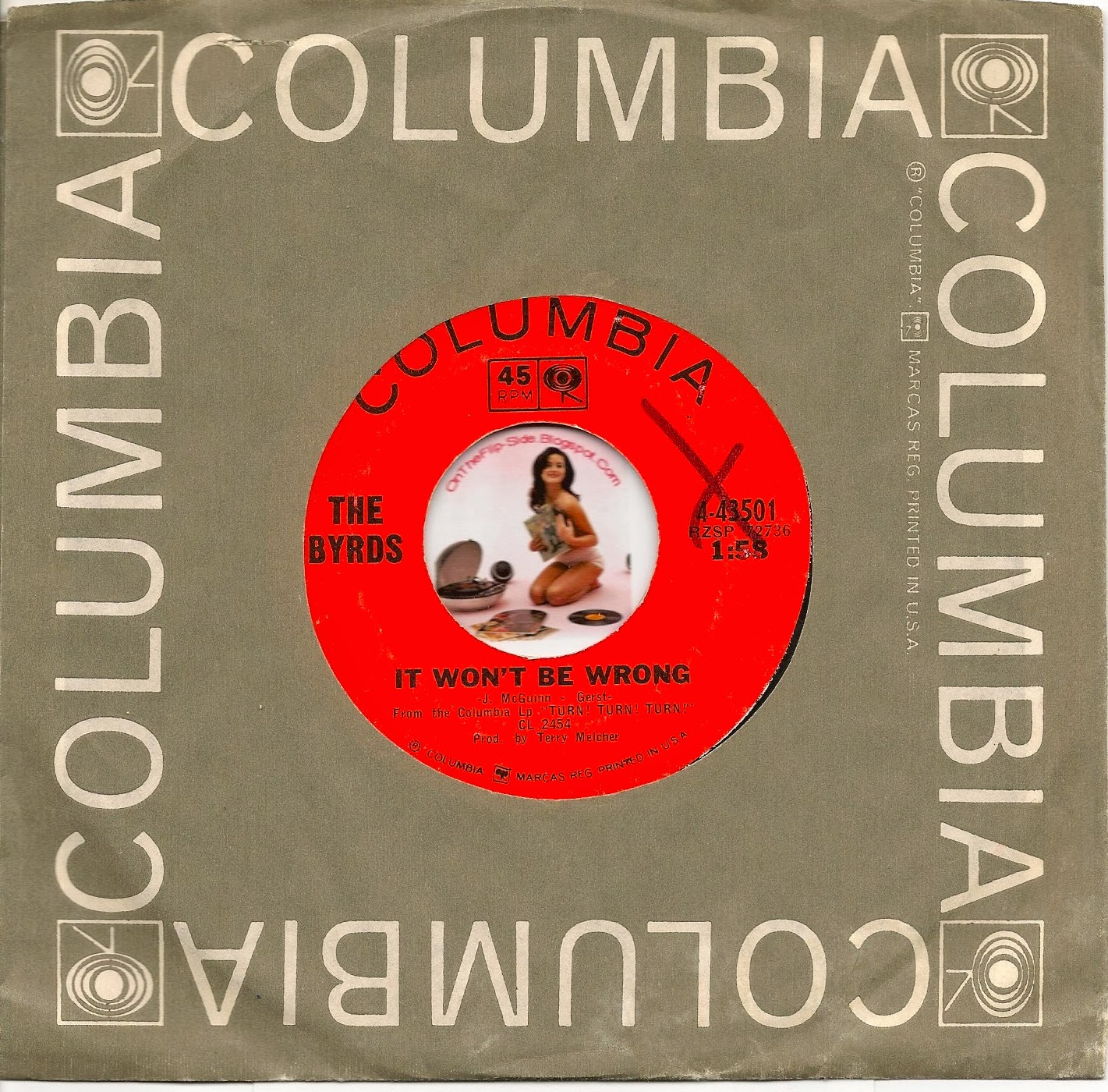
It Won't Be Wrong
For the fourth single, released on January 5, 1966, Gene Clark was given the A-Side with his melancholy song, Set You Free This Time, the first time an original had graced that coveted side of the record. That left Roger McGuinn to get the Flip-Side with his 1:58 composition, It Won't Be Wrong. It's an incredibly strong Flip-Side with a catchy guitar riff and some nice time changes that give the number a jazzy feel. Roger McGuinn sings the lead with Clark and Crosby harmonizing throughout.


Thursday, November 14, 2013

The Flip Sides of The Byrds' Singles: I Knew I'd Want You, I'll Feel A Whole Lot Better

As frequent readers of On The Flip-Side know by now, I'm a fan of Flip-Sides. That's often the place where the edgier, less pop oriented songs were relegated. And with the Byrds, particularly the early days, that's the place to where the band originals were relegated. We're going to spend the next few posts looking at the Flip-Sides of most all of the Byrds US singles discography through the 1960s. There are so many that we will double and triple up to cover them all.

We'll start today with the first two singles, both from 1965 for the titan of labels, Columbia Records.

I Knew I'd Want You
I Knew I'd Want You was the Flip-Side of the band's debut single, the brilliant cover of Bob Dylan's Mr. Tambourine Man. Roger McGuinn gets the lead on the A-Side, but here, on the Flip-Side, Gene Clark steps to the center of the mic on his own composition. The four singers of the band, Gene Clark, Chris Hillman, Rogert McGuinn and David Crosby were rarely ever better than on Clark's compositions. Dig the lush harmonies of McGuinn and particularly Crosby's tenor. Gene Clark didn't fly all that long with The Byrds. But his three years (and occasional returns) were incredibly important to the sound of the LA based band that rocketed to fame at the speed of sound. Gene Clark's compositions were brooding, most often slow (almost awkwardly slow) with unusual vocal phrasing and puzzling lyrics. I'm guessing that is Van Dyke Parks on the electric piano hidden way deep in the mix. 
I'll Feel A Whole Lot Better
The Gene Clark composition I'll Feel A Whole Lot Better may well be my favorite Byrds song of all time. Columbia toyed with the idea of releasing it as the A-Side of their second single, releasing it as a double sided promo on red wax in the US, before deciding to put it on The Flip-Side of another Dylan cover, All I Really Want To Do. I'll Feel A Whole Lot Better is clearly the superior of the two songs. Gene Clark again has the lead on his own composition, this time a more sprightly number with a slew of suspended chords that would become a trademark of The Byrds sound. Roger McGuinn's guitar work, from the jangly suspended chords to the lead, are just perfect. 


Friday, July 26, 2013

A&M Records Spotlight: The Flying Burrito Brothers - Older Guys

From 1970, we have the ground breaking Alt. Country pioneers, The Flying Burrito Brothers, performing Older Guys. Three members, Gram Parsons, Chris Hillman and Michael Clarke came from The Byrds. Bernie Leadon played guitar and also appeared on the Dillard And Clark song, Out On The Side, which was featured just two days ago. Sneaky Pete Kleinow rounded out the line up.

Until next time, we'll see you On The Flip-Side!

Wednesday, July 24, 2013

A&M Records Spotlight: Doug Dillard and Gene Clark - Out On The Side/Train Leaves Here This Morning

Out On The Side

Train Leaves Here This Morning
[originally posted, November, 2008]
Enigmatic. That might be the best word to describe Gene Clark. Unlucky, under appreciated, brilliant, secretive, phobic, handsome, distant, pioneer, shy, obtuse, complex. These words also describe the gentle throated Clark. For most, the word that comes to mind when they hear the name Gene Clark is...who? Okay, let me give a little back story on Clark before we move on to this week's song.

Gene Clark, while his name remains unrecognizable to most, has perhaps one of the most recognized voices in rock history. That's because Gene Clark, once a singer for the dreadful New Christy Minstrels (that's him singing beautifully at 2:03), was all-too-briefly, a founding member of The Byrds. From 1964-1966, Gene Clark was the smooth baritone voiced, tambourine tapping, harmonica playing, center-stage standing, lanky frontman of the world's coolest looking band, The Byrds. His voice created the perfect bottom to David Crosby's falsetto and Roger McGuinn's nasal midrange. But more than that, Clark was The Byrds' most prolific songwriter. In an era of American bands rushing to perform their best Beatles knock-off, Clark wrote (and sang) unique songs that owed as much to his rural Missouri roots as to any other influence. Lyrically his songs were introspective and approached the subjects in a roundabout manner that forced the listener to puzzle together the real meaning. Musically, Clark's Byrds-era songs, such as the stunning Set You Free This Time, featured unexpected chord progressions and strangely slow tempos that felt as if they had been slowed down after the recording was complete. So it was, at the height of The Byrds' success, Clark flew the nest. Nobody is quite sure exactly why. The most oft-told story is that his fear of flying forced him to leave The Byrds (we pause for the irony to sink in). But other stories include his stage fright forcing him out of the picture, his sense of guilt at receiving song-writing royalties when others, notably the loudly caustic Crosby, received none. Others say the seeds of dissatisfaction were sown when his (and The Byrds') standout song, I'll Feel A Whole Lot Better, was demoted to the flip-side of their second single in favor of a far lesser Dylan cover. It would happen again on the third single, where Clark's beautiful She Don't Care About Time would be relegated to the flip-side of a single (albeit the brilliant Turn, Turn, Turn).

Regardless of the reason, Clark left after the second album. Using The Byrds as his studio musicians, Clark released a handful of spotty, but poorly received singles as a solo artist. Quickly released from an impatient Columbia Records, Clark teamed up with bluegrass banjo-phenomenon Doug Dillard, seen here in an episode of The Andy Griffith Show performing his own composition. (Interestingly, fellow Byrds alumnus, Clarence White also appeared on the Andy Griffith Show! He's just off of Andy's shoulder.) As the Dillard & Clark Expedition, the two embarked on what may be the first ever country-rock group. Future Flying Burrito Brothers and Eagles member, Bernie Leadon joined on guitar, Michael Clarke (no relation) of the Byrds on drums. In 1968 they released their first single and one of Clark's best compositions ever, Out On The Side. I ran across it in a record store on 13th Street in Denver, Colorado the year after Gene Clark had died. I had never heard any of the solo work of Clark before. As a huge Byrds fan, and with Clark's obituary still in my mind, I plunked down $2 and walked home. I dropped the needle on the turntable and heard Andy Belling's Hammond organ open with a F#m chord as Clark lyrically inserts himself into the song as if we are catching him in mid-conversation. Leadon and Dillard harmonize as well as McGuinn, Crosby and Hillman could have done as the song rolls along with Clark's trademark dark, lumbering minor chord progressions. The lyrics, as obtuse as any he has written: "I have fallen through the black nights it seems/with the times that I've lied. And I've watched your thoughts stray into dreams/when you're not satisfied. But when the door closes before my eyes/Oh, I will cry/just to know you are going to stay, out on the side." Sixteen years later, it is still one of my favorite songs ever and that one $2 single has seen more plays on my turntable than can be counted.

One thing is for sure, Gene Clark was a musician's musician, a songwriter's songwriter. His reach touched many musicians. Between '66 and '74, Clark returned again and again to lend the Byrds his vocal skills as well as his penmanship, most notably co-writing and singing on the ground breaking recording of Eight Miles High, a song that documents his nervous breakdown on an airplane approaching London. The members of the Byrds likewise appeared on numerous solo recordings of Clark's. But the shadow he cast was much greater than just that of The Byrds. The stomach churning Eagles first recording was a cover of a 1968 Gene Clark song, The Train Leaves Here This Morning. And today his songs continue to get fresh play, as proven by the success of Robert Plant's and Alison Krauss' stunningly popular Raising Sand album which features no-less than two Gene Clark compositions: the droning Polly, Come Home and the country waltz of Through The Morning, Through The Night, both solo-era compositions. Dylan allegedly first hatched the idea to go electric after he appeared on stage with The Byrds in Los Angeles. And in a master becomes student moment, the Beatles' If I Needed Someone was a musical tip of the hat to The Byrds, whom the fab-four had watched record Bells of Rhymney and I'll Feel A Whole Lot Better in April of '65.

Clark's most famous band, The Byrds were inducted into the R-n-R Hall of Fame and spawned some of the most famous names in the business. Roger McGuinn carries on as the modern face and voice of the Byrds. David Crosby went on to become one of the most recognized names in the business. Chris Hillman and fellow-Byrd Gram Parsons formed the cult favorite, Flying Burrito Brothers using Gene Clark's guitarist, Bernie Leadon, who later went on to form the Eagles. Gene Clark? He died in 1991 at the far too young age of 48. A friend of mine had interviewed him for a publication called Ugly Things just a few years prior. He described to me a mellow, Earthy, nearly penniless man who clearly was drinking too much and living purposefully in anonymity. In the somber interview Clark distanced himself from his success with The Byrds and rejected the efforts to put him in the pantheon of great songwriters. That's his opinion. Mine is quite different of course.

Friday, February 8, 2013

Song of the Week: The Byrds -- It's All Over Now, Baby Blue


We close today with not one, but two -- that's right, TWO - versions of The Byrds performing It's All Over Now, Baby Blue. The blue version is an unreleased recording by the original line-up of The Byrds (Roger McGuinn, David Crosby, Chris Hillman, Gene Clark and Michael Clarke). It was recorded in Los Angeles in 1965, about the same time the Beckett Quintet recorded the song in the same town, and was slated to be the perfect pitched band's 3rd single on Columbia Records. The Byrds and their manager, Terry Melcher, were unsatisfied with the recording as a single and instead turned to another song which Roger McGuinn had been arranging, Turn, Turn, Turn. Somehow the Byrd's early version of It's All Over Now Baby Blue never got past a preview showing on a local LA radio station. Never even made it to an album. D'oh!

Roger McGuinn returned to Bob Dylan's song four years later in 1969. But this was a very different Byrds band. David Crosby was now a founding member of Crosby, Stills and Nash (yuck), Chris Hillman and Michael Clarke left to found The Flying Burrito Brothers with interim Byrds-alum, Gram Parsons. And Gene Clark was making some striking records with Doug Dillard. The version of the The Byrds who recorded this song were Clarence White, John York, Gene Parsons and, of course, McGuinn. This version did see the light of day in both the film and soundtrack for Easy Rider. Much slower, and much more countrified. It's still pretty cool and this line-up of The Byrds showed they could harmonize just about as well as the original line-up. 

Enjoy!

Wednesday, January 18, 2012

Song of the Week: The Byrds -- Have You Seen Her Face?

The Byrds were probably America's best band in an era dominated by the British Invasion. Not just clones of the Beatles or the Rolling Stones, The Byrds blended American country and western, pop and folk to create a beautiful new sound. That sound was most distinguished by the beautiful harmonies of four of the five members. By the time the band's fourth -- and best -- album Younger Than Yesterday was released,  Gene Clark (pictured above on the right and recipient of two Flip-Side posts in his post-Byrds career. Those are Out On The Side and Polly) had departed the band for good. With that departure the Byrds were now missing their strongest singer and perhaps their strongest songwriter. Tensions between David Crosby and the rest of the band were bubbling over and creating particular tension between the band and band leader Roger McGuinn.

From that bubbling cauldron, bassist Chris Hillman emerged, perhaps unlikely so, as a major creative force. Co-composer of the album's #1 hit single, So You Want To Be A Rock-N-Roll Star, Hillman also wrote and sang lead on four other songs on the album: Thoughts And Words, Time Between, The Girl With No Name, and today's SOTW, Have You Seen Her Face.


And more than that (if that wasn't enough), Hillman changed the sound of The Byrds, not just with his flatter, more countrified voice, but with the musicians he brought in to support his songs. Chris Hillman called on country guitar wizard Clarence White to play leads on Hillman's songs, essentially ditching The Byrds trademark 12-string chimey Rickenbacker as the lead instrument. Now we had the twang of a Fender Telecaster. This was a total rebranding of the Byrds that would become permanent as David Crosby would soon leave the band and be replaced by another Chris Hillman friend, Gram Parsons (himself a recipient of a Flip-Side post for his beautiful solo-era song, A Song For You). Of course those two would quickly leave The Byrds, along with drummer Michael Clarke, and form their own group, The Flying Burrito Brothers.

Have You Seen Her Face was released as a single in the US and died a miserable death on the charts. In some respects, it marks the beginning of the end of The Byrds' chart success. That doesn't mean the song isn't great, just that the stuff they were soon to record wasn't as radio friendly as before.

I've always had a soft spot in my musical heart for Chris Hillman. Not only was his bass work for the Byrds tremendous, but as noted above, his song writing and singing grew into it's own. As co-founder, and anchor, of the Flying Burrito Brothers, Hillman proved to be the corner stone in the creation of country-rock.

Enjoy Have You Seen Her Face.


Tuesday, December 7, 2010

Song of the Week: Dillard and Clark Expedition -- Polly


We present to you today a beautiful song that we have previously been reluctant to post on this site. We were hesitant because the song is so nuanced and so mellow, that we have feared the click-happy listener won't take the time to get it. But bollocks to the click happy world. This is a great song that you need to hear!

The song is Polly by the Dillard And Clark Expedition, a proto-alt country band that featured the former Byrds frontman, Gene Clark. We think so much of his work that he is only the third artist to get a repeat posting. [In fact, for a detailed history of Gene Clark, we strongly encourage you to read the article from two years ago about his song, Out On The Side, which can be accessed by clicking here.]

Polly is from the Dillard And Clark Expedition's second, and final, album, Through The Morning, Through The Night. It's one of the two songs from the 1969 album, along with the stellar title track, that was later covered by the Robert Plant, Alison Krauss collaboration album entitled Raising Sand. An excellent album produced by T-Bone Burnett, whom we suspect of bringing the songs to the table. With all due respect to the Plant/Krauss cover of this rare gem, I much prefer the Gene Clark version. Where Plant's performance is dark and brooding and heightens the sense of a stalker as our protagonist, Clark sings the song with a sense of loss and sadness that speaks nicely to a protagonist filled with the lament of "what could have been?".

If the wild bird could speak, he'd tell of places you have been
He's been in my dreams and he knows all the ways of the wind.
Polly come home again. Spread your wings to the wind.
I felt much of the pain as it begins.

The violin work of Byron Berline adds to that sense of sadness of loss and matches the acoustic guitar arpeggios at 1:22 and again at the end of the song, ever so nicely. We hope you take time to sit back and listen to this one without obstruction.